

Skip to content
IdeaScore
Applications

Build the form your call actually needs

A stage builder with eleven field types, conditions that hide questions until they apply, and windows that open and close on schedule. Applicants draft on the server, resume later and upload their deck directly.

11
field types
90
fields in one live form
20 MB
per file upload
250
capacity cap in the example call

The field types

  • Short text
  • Long text
  • Number
  • Email
  • Phone
  • Select
  • Multi-select
  • Date
  • File upload
  • Checkbox
  • URL

Every field can be required, carry helper text and be shown only when a condition is met.

How application forms work

Stage builder

Group the questions the way people answer them

Split a long application into stages — team, venture, documents — and applicants move through one screen at a time instead of scrolling a wall of fields. Reorder stages and fields by dragging, mark what is required, add helper text under anything ambiguous, and attach the guidance documents an applicant needs to answer well. The eleven field types cover everything a seed-fund or incubation form has ever asked for.

  • Stages, fields and helper text, all reorderable
  • Eleven field types, from short text to file upload
  • Required and optional marked per field
  • Resources attached to a stage, not buried in an email
Seed Fund 2026 · Cohort III

Venture

Venture nameShort text
SectorSelect
Stage of developmentSelect (TRL)
DepartmentSelect
Show when applying as is faculty
Pitch deckFile upload · PDF up to 20 MB
Conditions

Ask a question only when it applies

Every field can carry a show-when rule: show the department question only when the applicant is faculty, ask for a company registration number only when the venture is incorporated. Rules read in plain language in the builder and are evaluated as the applicant types, so the form shortens in front of them. Fewer irrelevant questions means fewer abandoned drafts and cleaner data at review.

  • Show-when rules on any field
  • Conditions read as a sentence, not as a formula
  • Evaluated live while the applicant types
  • Hidden fields are never submitted or scored
Seed Fund 2026 · Cohort III

Show Department when

Applying asisFaculty

Rules read as a sentence, and several can be combined on one field.

Applicant sees

Applying asFaculty
DepartmentMaterials Science
Shown by a condition
Student roll numberHidden
Versioning

Change the form without losing the last one

Every publish saves a version with who changed it and when. Preview the form as an applicant before you publish, compare what changed, and restore an earlier version if a question turns out to have been better worded the first time. Submissions stay attached to the version they were filled under, so a mid-call change never rewrites what someone already answered.

  • A version per publish, with author and timestamp
  • Preview as an applicant before publishing
  • Restore any earlier version in one action
  • Submissions keep the version they were filled under
Seed Fund 2026 · Cohort III

Form versions

181 submissions across 3 versions

  • v3
    Version 3Published

    18 Aug 2026 · Programme admin

    Added the incorporation question

  • v2
    Version 2

    02 Aug 2026 · Programme admin

    Reworded the traction stage

  • v1
    Version 1

    21 Jul 2026 · Organisation owner

    First published form

Each submission stays attached to the version it was filled under.

Windows and drafts

Open on schedule, close on capacity

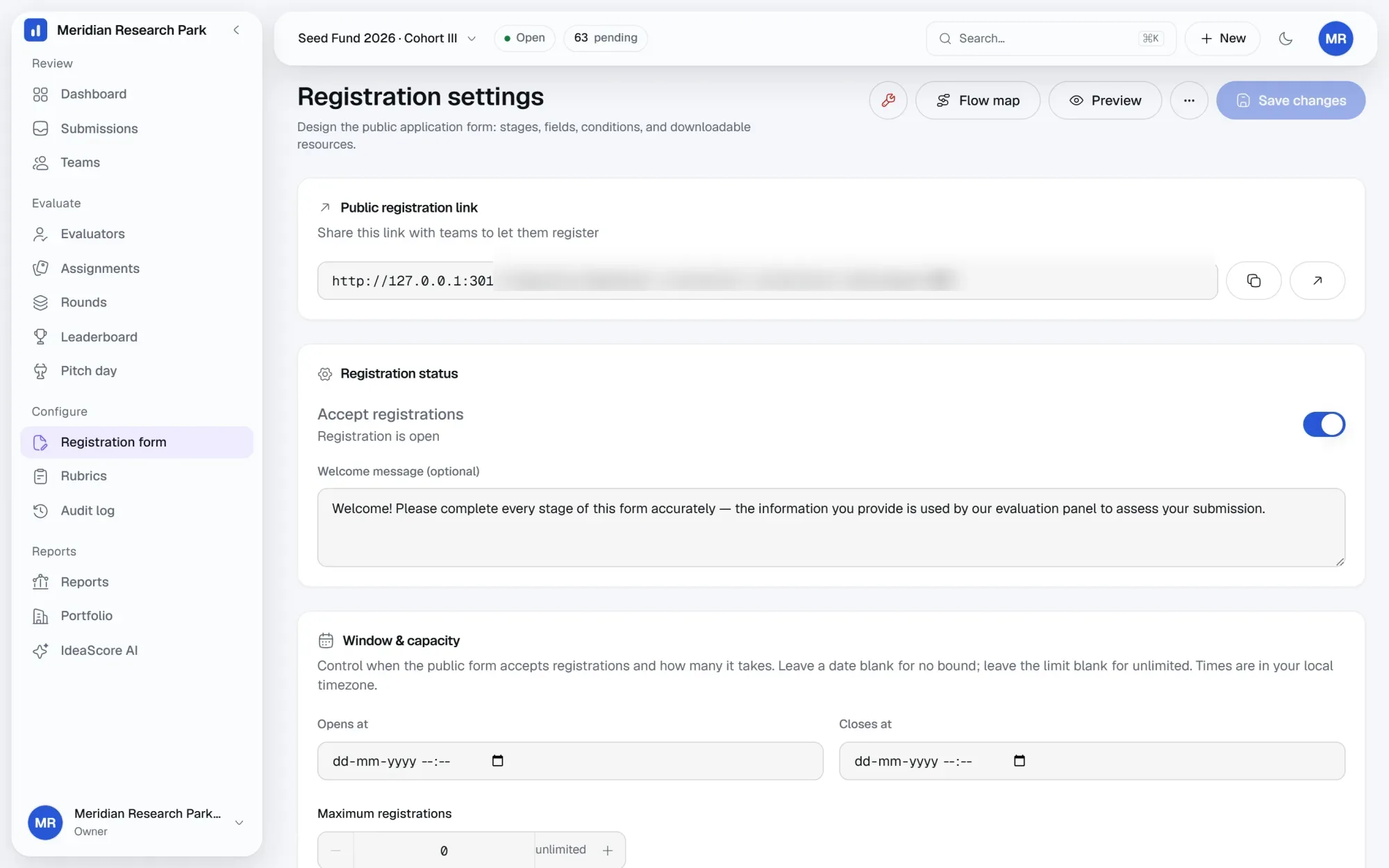
Set the dates a call accepts submissions and a cap on how many it takes. The public link shows a live window state, and applicants see the deadline on every screen. Drafts are stored server-side, not in the browser, so an applicant can start on a laptop in the office and finish on a phone that evening. Files upload straight to storage rather than through the form.
  • Registration window with open and close dates
  • Capacity limit with a live count against it
  • Server-side drafts, resumable on any device
  • Direct file uploads for decks and supporting documents
  • A public link you can put on the programme page
The registration settings page for a call, showing the public link, registration status, and the window and capacity controls.
Registration settings: the public link, window dates and capacity in one place
Specification

Everything in applications

  • Stage builder

    Multi-stage forms with drag-to-reorder stages and fields.

  • Eleven field types

    Text, number, email, phone, select, date, file, checkbox and URL.

  • Conditional fields

    Show-when rules evaluated live as the applicant answers.

  • Attached resources

    Guidance documents and templates sit beside the stage they belong to.

  • Registration windows

    Open and close dates with a visible deadline on every screen.

  • Capacity limits

    Cap the number of submissions and watch the count fill.

  • Versioning and restore

    A version per publish, with a one-action restore.

  • Applicant preview

    See the form exactly as an applicant will before it goes live.

  • Public link

    A shareable link for the programme page, poster or mailing list.

  • Server-side drafts

    Drafts persist across devices and sittings, not in the browser.

  • Direct file uploads

    Pitch decks and documents upload straight to storage.

  • Validation on submit

    Required fields, formats and file limits are checked before a record is created.

Questions programme teams ask

How long can an application form be?
There is no fixed limit. Live forms run to roughly ninety fields across several stages. Stages and conditions are what keep a form that size answerable.
Can applicants edit after submitting?
Yes, while the window is open. The applicant portal lets them reopen and edit, and each edit is recorded. Once the window closes the record is frozen for review.
What happens if we change the form mid-call?
Publishing creates a new version. Submissions already made stay attached to the version they were filled under, so nothing already answered is rewritten or invalidated.
What file types and sizes are allowed?
You set the accepted types per field. The usual configuration is PDF up to twenty megabytes for a pitch deck, with storage counted against your plan.
Do applicants need an account to start?
They sign in to the applicant portal with a magic link. That is what lets a draft follow them across devices and what lets them check their status later.

See IdeaScore run a call with your own rubric

A 30-minute walkthrough with a founder, using your programme's form and criteria.