

A co-evaluator that does its homework and shows its sources
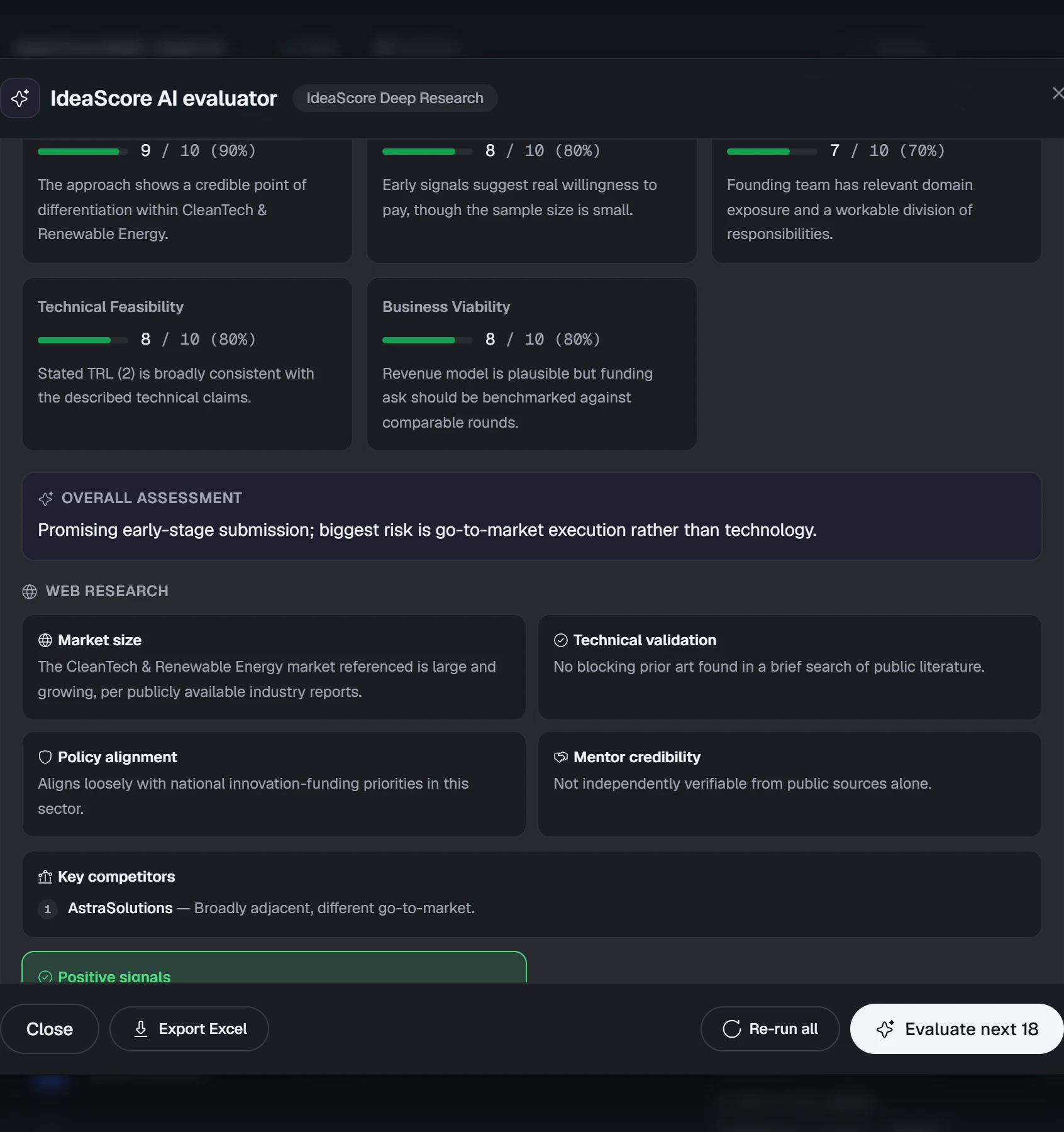
IdeaScore AI reads each application and its deck, researches the claim on the live web, and scores it against your rubric with a citation under every criterion. Its score sits beside the human scores and never replaces them.
- 9.5 / 10
- 9 / 10
- 9 / 10
- 9.5 / 10
- 9.5 / 10
Sources (6)
Six questions asked of every application
The same checks a diligent reviewer would run, on every submission rather than on the ten they had time for.

Market size
Competitors
Intellectual property and prior art
Mentor and founder credibility
Policy alignment
Technical feasibility
From application to cited score
A run takes a few minutes and produces a score, a rationale and a source list a reviewer can check.
Reads the application and deck
90 fields · deck, 14 slides
Searches the live web
market · competitors · patents
Scores each criterion with citations
46.5 / 50
Writes a reviewer summary
6 cited
How IdeaScore AI fits into a call
The AI score never overwrites a human one
Both scores sit on the same row against the same rubric. Where they agree, a reviewer moves on quickly. Where they disagree, the gap is the interesting part: the AI found a competitor the panel had not, or the panel met the founder and the AI did not. The blended view is a lens on the table, not a number written into the record — the human score remains the one of record throughout.
Catch the broken ones before a human opens them
Rule-based checks and IdeaScore AI run over the pile as it arrives: mandatory answers missing, a deck that will not open, a budget that does not add up, a venture that has already applied under another name. Flagged records come with a reason, and a programme admin decides whether to ask the applicant to fix it or to set it aside. Nothing is rejected automatically.
You set how much of it runs
IdeaScore AI is metered by evaluations per day, set by your plan and visible as a meter your team can see before they start a batch. A request log records every run with the submission, the person who started it and the outcome. When an application is edited after an evaluation, the evaluation is flagged as stale so nobody reads an old answer, and any programme can turn the module off entirely.
In the app, beside the work
IdeaScore AI is a page in the programme, not a separate tool. A reviewer opens a submission, reads the rationale, follows a source and scores it themselves.
Everything in IdeaScore AI
Grounded web research
Cited criteria
Pitch-deck extraction
Reviewer summary
Pre-screening
Cohort benchmarking
Daily quota
Request log
Staleness flags
Per-programme switch
Rubric-aligned
Human score of record
What people ask before switching it on
Does IdeaScore AI replace our evaluators?
What does it not do?
Where do the sources come from?
How is the quota counted?
What data leaves our server?
Can it be turned off for one programme?
See IdeaScore run a call with your own rubric
A 30-minute walkthrough with a founder, using your programme's form and criteria.