

Skip to content
IdeaScore
Platform

Run many organisations from one console, or run it yourself

Multi-tenant from the ground up: every organisation gets its own workspace, branding, plan and data. Operate it in our cloud, or take the same release and run it on your institution's own server.

5
roles, from platform admin down
4
subscription states
3
plans with feature flags
2
deployment options

Everything under the programme modules: who the organisation is, what its plan allows, what it looks like to an applicant, who is allowed to do what, and where the whole thing runs.

How the platform works

Multi-tenant

One console, many organisations

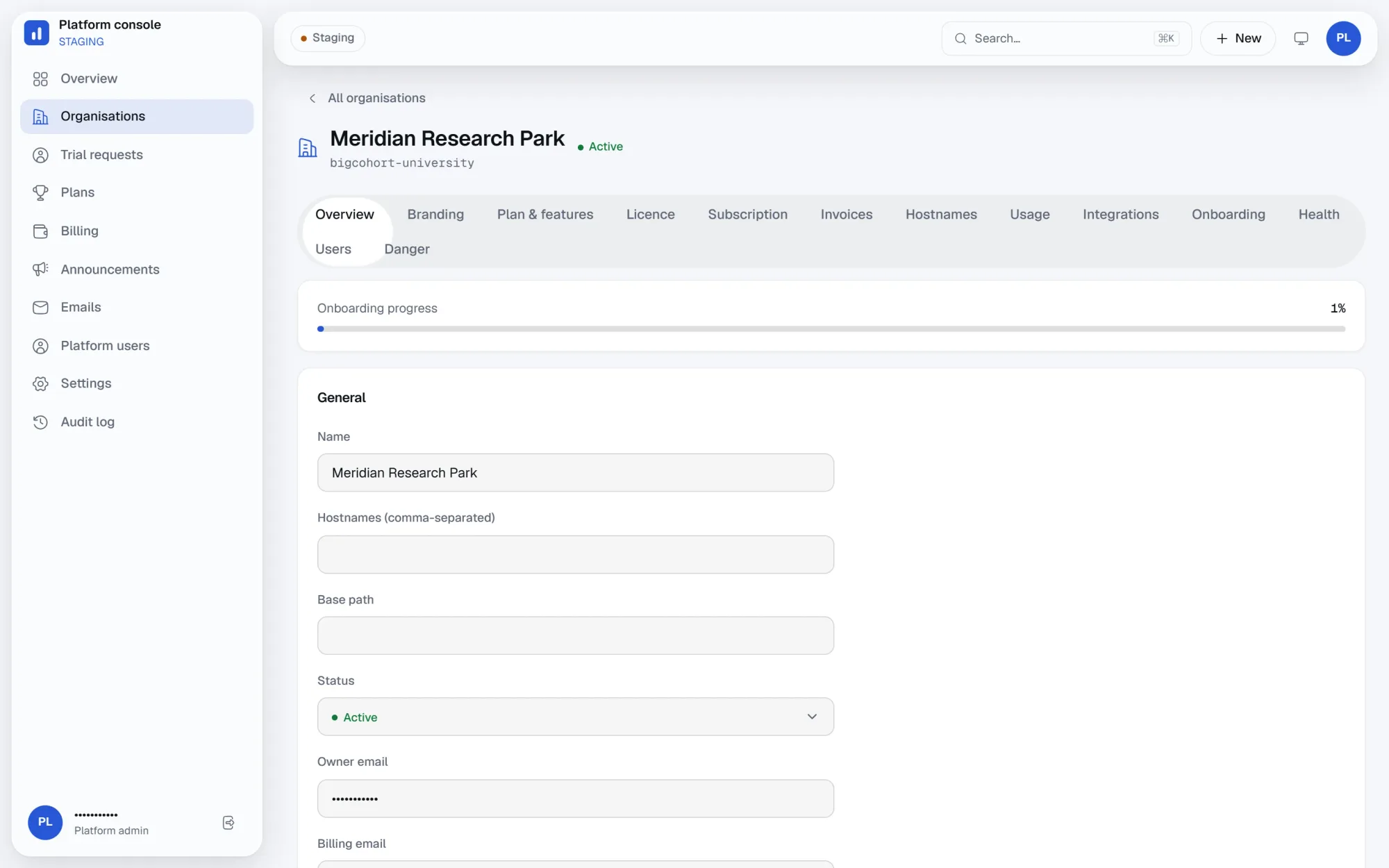
Each organisation is a tenant with its own programmes, users, files and settings, isolated from every other. The platform console provisions a tenant, assigns a plan, sets its feature flags and watches its health. A university group with several campuses can run each as its own organisation while a single operator keeps an eye on all of them.
  • Isolated data, users and files per organisation
  • Plans with feature flags rather than separate builds
  • Limits on programmes, submissions, evaluators and storage
  • Health, usage and announcements from one console
The platform console's organisation detail page, showing a tenant's plan, feature flags and settings.
The platform console: one organisation's plan, feature flags and settings
Onboarding

A checklist that gets a new tenant to their first live call

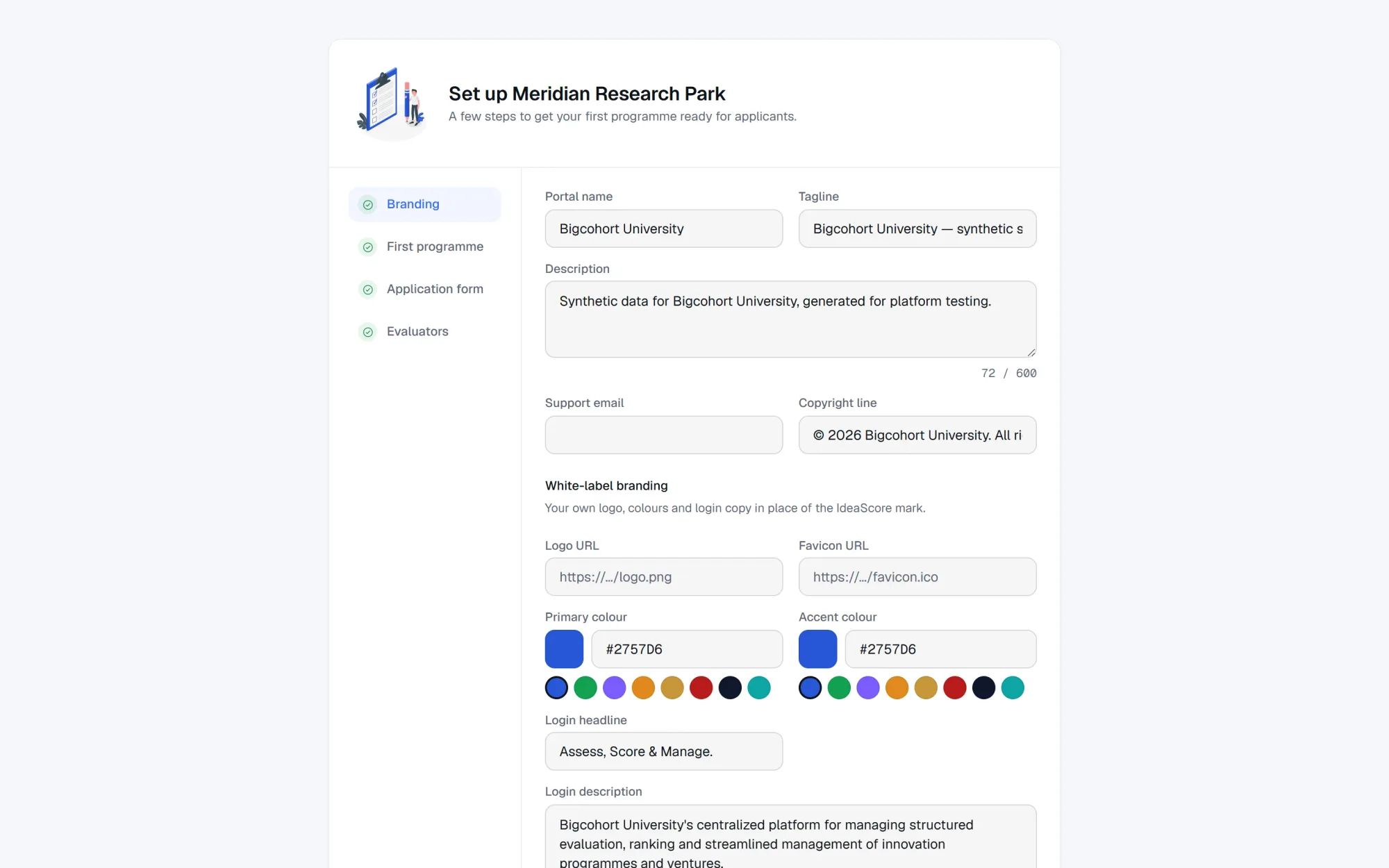
A new organisation lands on a step-by-step onboarding wizard rather than an empty console: brand the workspace, invite the first admins, publish a form. Progress tracks against a visible checklist, so a new tenant is running a call within the hour instead of guessing where to start.
  • A first-run wizard from branding to a published form
  • Progress tracked against a visible checklist
  • Sensible defaults an organisation can change later
  • The same wizard whichever way the tenant is provisioned
The onboarding wizard's branding step for a new organisation.
The onboarding wizard: branding is the first step, before a call ever opens
White-label

Your logo, your colours, your login page

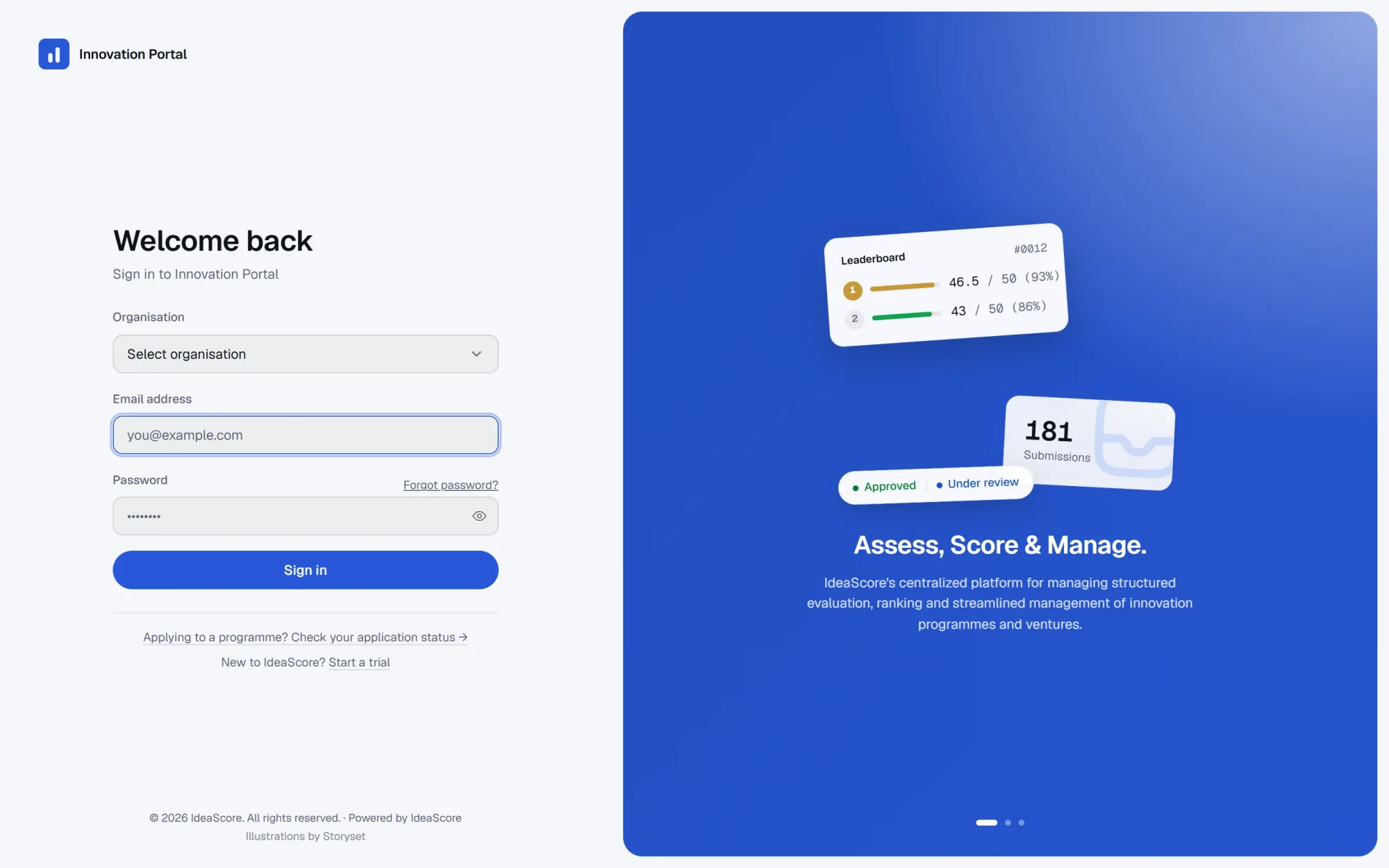
Branding is delivered per tenant at run time: logo, brand colour, login copy and the product name shown to applicants. A team that lands on your call sees your institution, not ours. Because the whole interface is driven by tokens rather than hard-coded colour, a tenant re-skins without a code change and without a separate deployment.
  • Logo, brand colour and login copy per organisation
  • Applied everywhere, including the applicant portal
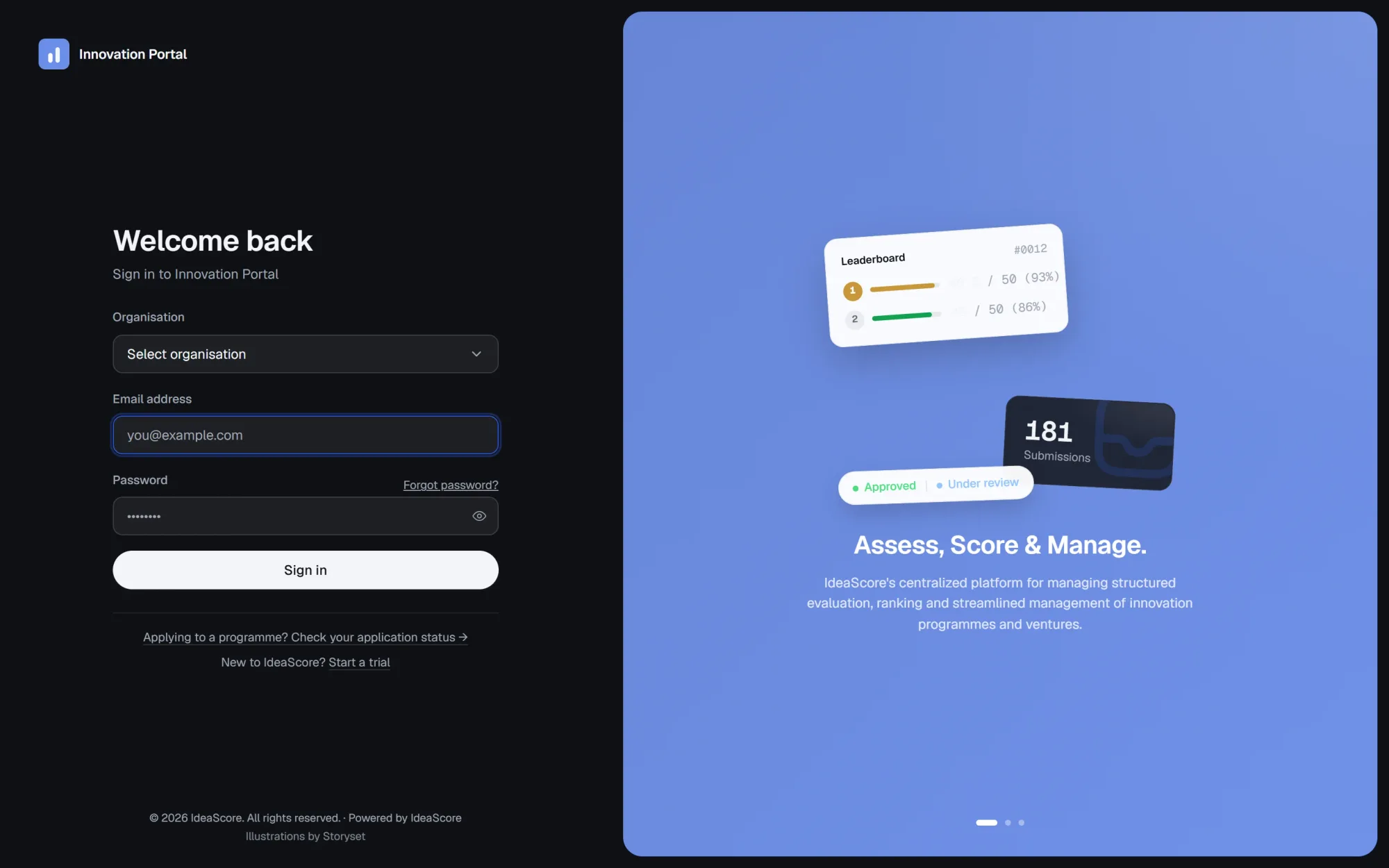
  • Light and dark mode, both respecting the brand colour
  • No separate build and no code change to re-skin
The IdeaScore sign-in screen in light mode, showing where a tenant's logo, brand colour and login copy appear.
Light mode
The IdeaScore sign-in screen in dark mode, with the same tenant branding carried through.
Dark mode
Access and safety

Five roles, an audit trail and a second check

Platform admin, organisation owner, programme admin, evaluator and applicant, each seeing only what their work needs. Sessions lock after inactivity, sensitive edits ask for the password again, and every consequential action is written to the audit trail. Backups run on a schedule, and email notifications keep people informed without anyone chasing.

  • Role-based access across five roles
  • Session lockout after inactivity
  • Password re-authentication for sensitive edits
  • Audit trail across the organisation, not just one programme
  • Scheduled backups and email notifications

Roles

Narrowing scope, top to bottom

  • Platform admin

    Provisions tenants, plans and announcements across the platform

  • Organisation owner

    Branding, billing, staff and every programme in the organisation

  • Programme admin

    One programme: form, review, evaluators, rounds and reports

  • Evaluator

    Only the submissions assigned to them, and only their own scores

  • Applicant

    Their own application, drafts and status

Sessions lock after inactivity; sensitive edits ask for the password again.

Deployment

Our cloud, or the server your IT team already runs

The cloud option is app.ideascore.online: provisioned in minutes, backed up and kept current by us. The self-hosted option is the same release in Docker, or Apache with PM2 on a virtual machine inside your network, under its own path. Data residency is a deployment choice rather than a paid add-on.

  • Our cloud at app.ideascore.online, updated weekly
  • Docker, or Apache with PM2 on your own virtual machine
  • Served under your domain and path
  • Identical feature set either way

Deployment

Same release, either way

IdeaScore Cloud

app.ideascore.online

Provisioning
Minutes
Updates
Weekly, by us
Backups
Scheduled, off-site
Your own server

your-domain/innovation

Runtime
Docker, or Apache with PM2
Data
Inside your network
In production since
2025

Moving between the two is an export and an import, not a rebuild.

Subscriptions

Nothing is ever deleted when a plan lapses

A subscription moves through four states and never deletes anything. A trial has the full feature set. Active applies the plan's limits. Grace keeps the workspace writable while an invoice is settled, with a visible warning. Read-only pauses editing but leaves every record intact and exportable, because a programme's data is the institution's, not ours.

  1. Trial

    Full features for the evaluation period.

  2. Active

    Paid, with the plan's limits applied.

  3. Grace

    Past due, still writable, warnings shown.

  4. Read-only

    Data intact and exportable, editing paused.

Specification

Everything in the platform

  • Organisations

    Isolated tenants with their own programmes, users and files.

  • Plans and feature flags

    Capabilities switched per plan, not per build.

  • Subscriptions

    Trial, active, grace and read-only, with nothing deleted.

  • Invoices

    Issued, tracked and downloadable from the console.

  • Announcements

    Messages to one organisation or to every tenant.

  • Onboarding checklist

    First-run steps from branding to a published form.

  • White-label branding

    Logo, colours and login copy per organisation.

  • Light and dark mode

    Both themes, both honouring the tenant's brand colour.

  • Role-based access

    Platform admin, owner, programme admin, evaluator, applicant.

  • Session lockout

    Sessions end after inactivity and ask for sign-in again.

  • Re-authentication

    Sensitive edits ask for the password a second time.

  • Audit trail and backups

    Organisation-wide history and scheduled backups.

On the roadmap

  • Single sign-on

    Coming soon

    SAML and OIDC against your institution's identity provider.

  • Public API

    Coming soon

    Read and write programmes, submissions and scores from your own systems.

Questions IT teams ask

What does self-hosting actually require?
A virtual machine your IT team already runs, with Docker, or Apache with PM2. The release is the same one our cloud runs, and institutions operate it this way today.
Who owns the data?
Your organisation. It is exportable in every subscription state, including read-only, and on a self-hosted deployment it never leaves your network except for features you switch on.
Is single sign-on available?
Not yet. SSO and the public API are on the roadmap and are marked coming soon wherever they appear. Everything else described on this page is shipped.
What happens when a subscription lapses?
It moves to grace, which keeps the workspace writable while an invoice is settled, and then to read-only. Read-only pauses editing but keeps and exports every record.
How much can we re-brand?
Logo, brand colour, login copy and the product name applicants see, across the whole interface including the portal. The structure and layout stay ours so upgrades apply to every tenant.
Can we move from your cloud to our own server later?
Yes. It is the same release and the same data model, so a migration is an export and an import rather than a rebuild.

See IdeaScore run a call with your own rubric

A 30-minute walkthrough with a founder, using your programme's form and criteria.